
Methodology
How do we build a game app that actually sticks?
We start with player psychology, not aesthetics. Every pixel, every animation, and every micro-interaction is stress-tested against a single, ruthless question: does this deepen the player's commitment or add friction?
When to Use Our Process
- ✓ You need a unique visual identity, not a template.
- ✓ Player retention is a known, measurable bottleneck.
- ✓ Your team values deep iteration over rapid, generic sprints.
- ✓ You're preparing for a competitive launch (not a soft release).
It Optimizes For:
Sustained engagement, brand loyalty, and long-term LTV.
The Investment Trade-off
Constraints That Shape Our Work
- Apple’s App Review Guidelines can reject ambiguous UI. Our process includes a "Store Readiness" checkpoint.
- Multi-platform requirements (iOS/Android) often fracture visual consistency. We build a core system, then adapt.
- GDPR & data privacy rules limit certain analytics. We focus on behavioral heuristics, not PII.
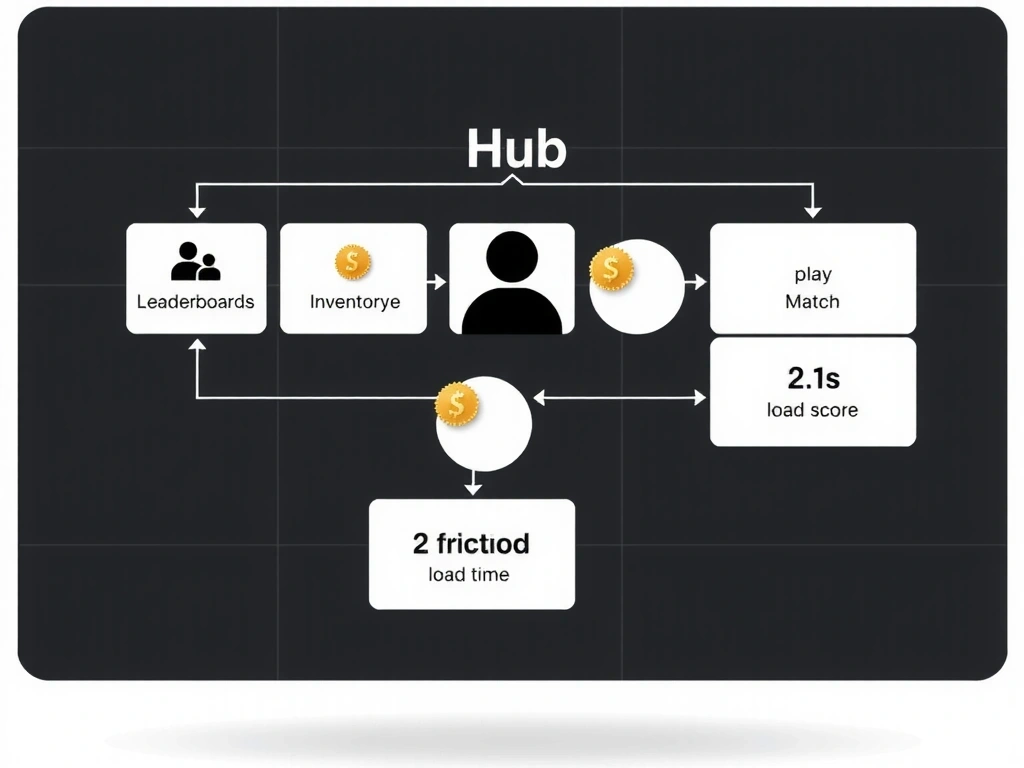
Artifact: Core Loop Deconstruction
Mapping the Player's Mind Before a Line of Code is Written
We don't guess what players want. We begin by constructing a mental model. This involves defining 3-5 core psychographic archetypes—like The Completionist who tracks every achievement, or The Social Explorer driven by interaction. This isn't marketing fluff; it's a design constraint that dictates every subsequent choice.
Parallel to this, we execute a competitive gap map. We analyze top competitors not just visually, but behaviorally. Where do they frustrate the user? Where is their onboarding ambiguous? Our grid isn't about features; it's about psychological openings. The deliverable is a single, clear document: a "Player Empathy Map" that the entire project team aligns on, becoming our North Star for the remainder of the engagement.
"Without the empathy map, we're just decorating. With it, we're engineering an experience."
From Discovery to Launch: The Four Pillars
A structured methodology designed to de-risk creativity and deliver a polished product.
Discovery & Strategy
• Player archetype workshop
• Competitive gap analysis
• Core loop deconstruction
Deliverable: Empathy Map & Strategy Brief
Visual Syntax & System
• Moodboard to master style guide
• 5-second rule clarity test
• Motion & accessibility integration
Deliverable: UI Style Kit & Component Library
Interactive Prototyping
• Low-fi to high-fi iteration
• 'Broken button' stress tests
• Technical feasibility review
Deliverable: Clickable Figma Prototype
Polish & Launch Readiness
• 50-point QA gauntlet
• Storefront asset optimization
• 90-day post-launch roadmap
Deliverable: Launch Kit & Analytics Plan
How We Evaluate Robustness
Our process isn't theoretical. It's stress-tested against real-world constraints. For a deeper look into our evaluation criteria, limits of the methodology, and what would change our approach, open our internal method note.
Ready to pressure-test your app concept?
Let's discuss your project's core loop and where our process can accelerate it.
Start the Conversation